

EU Presidency Series: Securing Irish Government in a High-Stakes Year #6
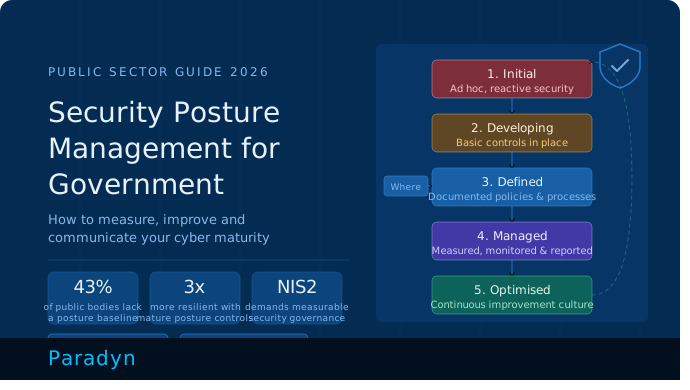
By this point in the series, your organisation should have a clearer picture of its risk landscape, a more disciplined approach to patching, a vulnerability management programme in motion, and stronger identity controls in place. Each of those is a meaningful step. But individually, they are still components. What ties them together — and what ultimately determines whether an organisation is genuinely resilient or merely less vulnerable — is security posture.
Security posture is the term used to describe an organisation’s overall defensive capability: not just the tools it has deployed, but how effectively they are configured, monitored, and maintained; how well staff understand and follow security processes; and how quickly the organisation can detect, respond to, and recover from an incident when one occurs.
Getting posture right is the difference between an organisation that survives a serious cyber incident and one that doesn’t.
From reactive to proactive: what the shift looks like
Most public sector IT teams spend the majority of their security time in reactive mode — responding to alerts, resolving incidents, chasing patches, handling helpdesk requests. This is understandable. The day-to-day demand is real. But a purely reactive security function is one that is always a step behind the threat.
Proactive security is not about predicting the future. It is about systematically reducing the conditions that allow attacks to succeed, and building the detection and response capability to catch the ones that get through anyway.
In practice, the shift involves several things happening in parallel.
Visibility: you can’t respond to what you can’t see
The foundation of proactive security is visibility — a continuous, accurate picture of what is happening across your environment. This typically means having a Security Information and Event Management (SIEM) system or equivalent capability that aggregates logs from across your infrastructure, applies detection rules, and surfaces anomalies that warrant investigation.
Many Irish public sector organisations have some logging in place but lack the centralisation and analysis capability to turn raw logs into actionable intelligence. Events that would, in retrospect, have signalled a breach in progress — unusual authentication patterns, unexpected outbound connections, privilege escalation on systems that don’t normally see it — pass unnoticed.
Investing in visibility is not glamorous. It requires configuration work, ongoing tuning, and a human process for reviewing and acting on alerts. But it is what enables an organisation to catch an incident early, when the damage is still limited, rather than weeks later when it has spread.
Detection and response: shortening the dwell time
The average dwell time — the period between an attacker gaining access and an organisation detecting the intrusion — remains measured in weeks or months across many sectors. During that time, attackers are typically establishing persistence, escalating privileges, moving laterally, and exfiltrating data. The longer the dwell time, the greater the damage.
Organisations that have invested in proactive detection capability consistently achieve shorter dwell times and significantly better incident outcomes. Key elements include:
Endpoint & Managed Detection and Response (EDR & MDR) . Modern EDR & MDR tools and services provide visibility into activity on individual devices — detecting behavioural patterns consistent with malware, lateral movement, or credential misuse — in a way that traditional antivirus cannot.
Network monitoring. Visibility into traffic flows across your network enables detection of unusual patterns: large data transfers, connections to known malicious infrastructure, lateral movement between systems that don’t normally communicate.
Threat intelligence integration. Knowing what threat actors are actively doing — the techniques they’re using, the infrastructure they’re operating from — allows detection rules to be tuned to the actual current threat rather than generic historical patterns.
Defined incident response procedures. When an alert fires, who does what? In the absence of a defined, practised incident response plan, organisations lose critical time to confusion. The plan doesn’t need to be elaborate — it needs to be clear, current, and known to the people who will execute it.
The human layer: security culture matters
Technology alone cannot deliver a strong security posture. The human layer — staff awareness, behaviours, and culture — is consistently one of the most significant factors in both the success and failure of security programmes.
Phishing simulation programmes, regular security awareness training, and clear policies around acceptable use, device management, and incident reporting all contribute to a culture where security is understood as a shared responsibility rather than the IT team’s problem.
For Irish public sector organisations, where staff may be handling sensitive policy information or operating in contexts that make them attractive targets for social engineering, investment in the human layer is at least as important as investment in technology.
Measuring and communicating posture
One of the hallmarks of a mature security function is the ability to measure its own effectiveness and communicate it clearly to senior leadership. This means having meaningful metrics — not raw counts of alerts, but indicators of actual security outcomes: mean time to detect, mean time to respond, patch compliance rates, percentage of assets covered by monitoring, number of open critical vulnerabilities and their age.
Senior leaders in public sector organisations are increasingly being held accountable for cybersecurity outcomes — by government policy, by the NIS2 Directive, and by the expectations of the public they serve. Giving them a clear, honest picture of where the organisation stands is both a governance obligation and a practical necessity for getting the resource and attention security programmes need.
Your action this fortnight
Step back from the individual controls and ask the broader question: does your organisation have a documented, current understanding of its security posture? Is there a person or team responsible for maintaining that picture and reporting on it? Is there a defined target state — not just “more secure than we are now,” but a specific set of capabilities and standards to achieve?
If the answer to any of those questions is no, that is where the next conversation needs to happen — and it needs to happen at senior leadership level, not just within the IT team.
Paradyn supports Irish public sector organisations in assessing, measuring, and systematically improving their security posture. To set up a conversation about where your organisation stands and where it needs to go, reach out to the Paradyn team today.