

EU Presidency Series: Securing Irish Government in a High-Stakes Year #4
If patching is about fixing known problems, vulnerability management is about continuously finding them. The two are closely related — but they are not the same thing, and the distinction matters.
Many organisations treat vulnerability management as a synonym for patching, or as a once-a-year exercise tied to an audit or compliance review. In a threat environment as active as the one Irish government organisations are navigating right now, that approach leaves dangerous gaps. Effective vulnerability management is a continuous cycle, not a point-in-time event.
Patching versus vulnerability management
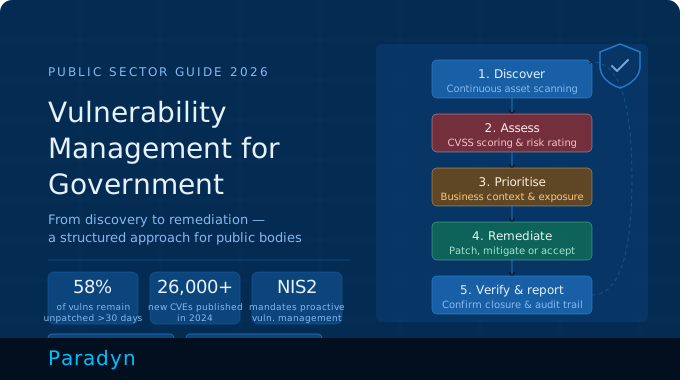
Patch management, as covered in the previous post in this series, is about deploying vendor-issued fixes for known software flaws. Vulnerability management is broader. It encompasses:
- Discovery: Continuously scanning your environment to identify vulnerabilities — including configuration weaknesses, missing patches, exposed services, and misconfigurations — before attackers find them
Assessment: Evaluating the severity of each finding in the context of your specific environment, not just its generic CVSS score
Prioritisation: Deciding which vulnerabilities to fix first, based on exploitability, asset criticality, and business impact
Remediation: Fixing, mitigating, or formally accepting each risk — and tracking that to closure
Verification: Confirming that remediations were effective and that the vulnerability no longer exists in your environment - Patch management feeds into this cycle as the primary remediation mechanism for software vulnerabilities. But vulnerability management is the governance layer that ensures patching happens in the right order, at the right pace, and doesn’t miss the things patching alone can’t fix.
What continuous scanning reveals
Organisations that run their first thorough vulnerability scan are often surprised by what they find. Not because their IT teams have been negligent, but because complex environments accumulate risk in ways that aren’t visible without actively looking.
Common findings include:
- Forgotten or shadow IT assets. Systems that were stood up for a project and never decommissioned. Legacy servers that fell off the asset register but are still running. Test environments that were never properly secured. All of these represent real attack surface.
- Misconfigured services. A service that is correctly patched but incorrectly configured can be just as exploitable as an unpatched one. Default credentials, unnecessary open ports, and overly permissive access controls are consistently among the most common findings in public sector environments.
- Vulnerabilities in network devices and firmware. Routers, switches, and firewalls are often overlooked in vulnerability programmes that focus primarily on servers and endpoints. They are frequently under-patched and can offer attackers significant leverage if compromised.
- Third-party and open-source software risk. Modern applications commonly contain dependencies on open-source libraries. Vulnerabilities in those libraries — like the Log4Shell incident that sent shockwaves through the industry in 2021 — can be extremely difficult to track without tooling specifically designed for the purpose.
The role of penetration testing
Automated vulnerability scanning tells you what is there. Penetration testing tells you what an attacker could actually do with it.
A penetration test involves skilled security professionals attempting to exploit vulnerabilities in a controlled, authorised way — simulating what a real threat actor would do if they targeted your organisation. It is one of the most valuable investments an organisation can make in understanding its true security posture, and it consistently surfaces risks that scanning alone misses.
For Irish public sector organisations during the Presidency period, commissioning a penetration test of externally accessible systems is a particularly worthwhile step. Understanding your exposure from the outside — exactly as an attacker would see it — is clarifying in a way that internal assessments rarely are.
Prioritisation: the hardest part
The output of a mature vulnerability scanning programme is typically a large volume of findings. Without a principled approach to prioritisation, that volume can be paralysing.
Effective prioritisation takes into account:
- Exploitability in the wild. Is this vulnerability being actively exploited by real threat actors right now? ENISA, CISA, and other agencies publish threat intelligence that helps answer this question.
- Asset criticality. A critical vulnerability on a public-facing authentication system demands different urgency than the same vulnerability on an isolated development server.
- Compensating controls. Is there something else in your environment — a firewall rule, a network segment, an access control — that meaningfully reduces the exploitability of this vulnerability in your specific context?
- Remediation complexity. Some fixes are quick wins. Others require change management, testing, and planned downtime. Understanding the effort involved helps with realistic scheduling.
The goal of prioritisation is not to deprioritise risk — it is to ensure that the most dangerous risks get the fastest attention, rather than being lost in a queue of lower-severity findings.
Your action this fortnight
If your organisation does not have a scheduled, recurring vulnerability scan running against your environment, establishing one is the priority. If you do have scanning in place, review the age of your oldest unresolved findings — particularly any rated critical or high severity. If you have findings that have been open for more than 30 days without a remediation plan, that is a gap that needs to be closed.
Visibility is the foundation. You cannot manage what you cannot see.
Paradyn provides vulnerability management services tailored to the complexity and compliance requirements of Irish public sector organisations. To set up a conversation about your vulnerability posture, reach out to the Paradyn team today.